

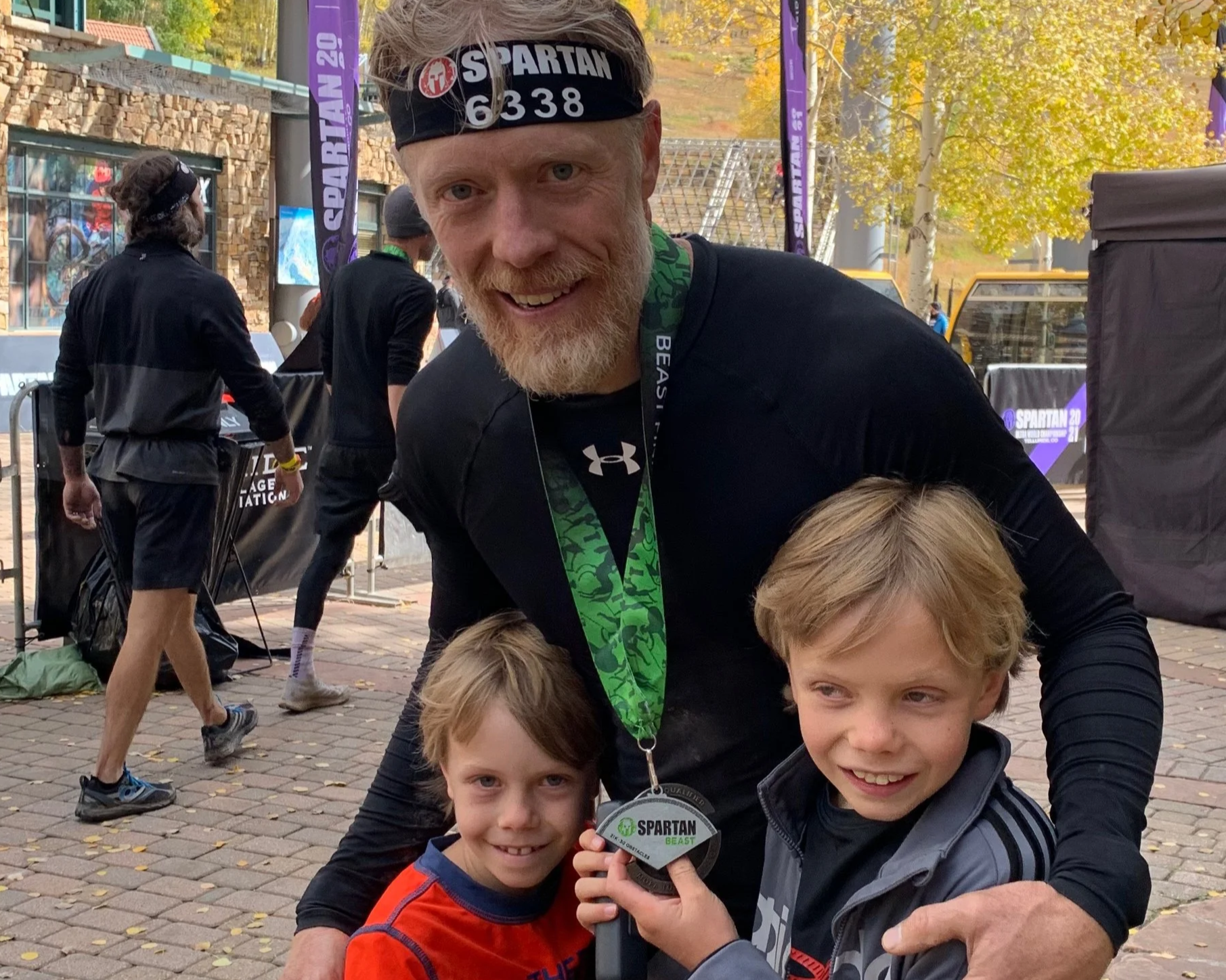
Prioritizing health & fitness supported me and others in several ways. At the finish of a Spartan Race in 2021 with my boys.
Being a leader is hard.
And maybe it isn't just the job.
Maybe it's the condition you're bringing to it.
We spend a lot of time talking about leaders. What they know. How they communicate. How they make decisions. How they build culture. How they hold others accountable.
We talk about leadership skills, competencies, frameworks, and strategies. We talk about emotional intelligence, psychological safety, resilience, and the ability to navigate complexity.
All of that matters.
But underneath all of it is a person.
A person who eats, drinks, sleeps, moves, recovers and connects with other people.
A person who carries stress, disappointment, uncertainty, responsibility, and expectations.
A person whose body and mind show up to work every single day, whether they are ready for it or not.
And that person matters.
Because leadership doesn't happen in a vacuum.
It happens in a human body.
What does your physiology have to do with leadership?
William Glasser's Choice Theory offers an interesting way of thinking about this.
Glasser described what he called total behavior as having four interconnected components: feelings, physiology, thoughts, and actions.
He used the analogy of a car. Feelings and physiology are like the back wheels. They generate the energy. Thoughts and actions are like the front wheels. They help determine where we go.
We tend to focus heavily on the front wheels.
What are you thinking? What decisions are you making? How are you behaving? How are you communicating?
But what if the condition of the back wheels affects how well we can steer?
Consider elite athletes.
Professional athletes don't just practice their sport. They pay extraordinary attention to the condition of the person performing it.
They monitor sleep.They manage nutrition.They train their bodies.They track recovery.They pay attention to stress.They limit things that compromise performance.
Why?
Because they understand something that leaders sometimes forget:
Performance depends, at least in part, on the condition of the person performing.
A study discussed on the WHOOP podcast looked at physiological and lifestyle factors among roughly 300 professional golfers. Researchers looked at things like sleep quality and consistency, resting heart rate, heart rate variability, stress and recovery, alcohol consumption, and exercise.
The relationship between health and performance was striking.
The healthiest group performed roughly two strokes better per tournament than the least healthy group.
Two strokes.
At the professional level, that's enormous. A difference in earnings in the millions of dollars.
And it raises an interesting question:
What would happen if leaders paid the same attention to the condition of the person doing the leading?
I know this because I've lived it.
There was a period in my career when life felt pretty unrelenting.
I was leading at Open Sky, working long weeks and carrying a significant amount of responsibility. I was on call. We had two young kids at home, four and two years old, and my wife was working too. There were the everyday challenges of raising a family, the logistics and conflicts around domestic duties, and the constant demands of running a complex organization.
There was a lot going on.
And I wasn't taking particularly good care of myself.
I wasn't sleeping enough. I was carrying more weight than I do today. I had bouts of low energy. I wasn't moving my body consistently. I wasn't recovering particularly well.
I was doing what a lot of leaders do.
I was taking care of everything else.
And putting myself somewhere down the list.
Looking back, I can see how much that mattered.
I wasn't a bad leader.
I had experience. I cared deeply about the people and the organization. I cared about my wife and family. I was working hard on both fronts.
I was committed to doing my best. But I wasn't bringing my best.
I was more reactive.
Less patient.
Less energetic.
Less resilient.
And probably less curious than I could have been.
The job was hard. And home was demanding.
But I eventually had to ask myself:
Was the job the only thing making it hard?
Then I stumbled into CrossFit.
A colleague invited me to join a class.
My first few workouts were humbling. They were hard enough that I occasionally wondered if I can keep up.
But something happened.
I remembered how much I loved moving my body.
I'd spent much of my life outdoors and physically active. Movement had always been one of the ways I dealt with stress. Whether it was hiking, skiing, running, backpacking, or simply being outside, physical activity gave me a way to get out of my head and back into my body.
At some point, though, I'd lost some of that.
The demands of work and family had accumulated. My physical activity became more sporadic—an adventure here, a gym session there, a run when I could fit one in.
And eventually I was carrying nearly 30 pounds more than I am today.
CrossFit classes changed that for me.
Not because it was magical. Because it made consistency easier.
I didn't have to figure out what workout I was going to do. Someone else had programmed it. I didn't have to convince myself to exercise. I just had to show up.
There were coaches.
There were other people.
There was accountability.
And there was something I hadn't realized I was missing: I actually enjoyed pushing myself physically and doing hard things with other people. Just like all those years of youth sports.
Over time, I felt different.
I had more energy.
I slept much better.
I felt stronger.
I was more comfortable in my own body.
And I think I became a better leader because of it.
Not because CrossFit taught me how to lead.
But because it helped me take better care of the person who was doing the leading.
Your physiology is part of your leadership toolkit.
Leadership in behavioral healthcare isn't easy.
Leaders are routinely asked to make important decisions with incomplete information. They navigate crises, competing priorities, difficult conversations, financial pressures, staffing challenges, changing regulations, and the emotional weight of caring for people in vulnerable circumstances.
They need to stay curious when it's easier to become defensive.
They need to listen when they already think they know the answer.
They need to regulate themselves when everyone around them is activated.
They need to make good decisions when the path forward isn't obvious.
They need to be steady without becoming rigid.
They need to be resilient without simply becoming numb.
Those are leadership capabilities.
But they're also human capabilities.
And our ability to access them is influenced by the condition we're in.
Chronic sleep deprivation doesn't make you a bad leader.
Neither does having a few drinks.
Neither does eating poorly, sitting too much, skipping exercise, neglecting relationships, or going too long without meaningful recovery.
But all of those things can affect the person who walks into the room.
And when the demands are high, small deficits in capacity can become significant.
You may be more reactive.
More impatient.
More easily frustrated.
Less able to listen.
Less willing to entertain another perspective.
Less creative.
Less curious.
Less capable of making the kind of thoughtful decisions you know you're capable of making.
You may simply have less capacity available to you.
You may be leaving capacity on the table.
The uncomfortable leadership question
This isn't about becoming a perfect human being.
I'm certainly not.
It's not about optimizing every metric, eliminating every indulgence, or turning your life into some kind of high-performance experiment.
It's about paying attention.
What does your sleep look like?
Are you moving your body?
How are you fueling yourself?
What role does alcohol play in your life?
Are you spending time with people who matter to you?
Do you have a life outside of work that gives you energy and perspective?
Are you creating space to think, reflect, play, laugh, and simply be?
And perhaps the bigger question:
Are you taking care of the person underneath the leader?
Because that person is the one who has to make the decisions.
That person has to walk into the difficult conversation.
That person has to sit with uncertainty.
That person has to lead through the crisis.
That person has to go home at the end of the day and be a partner, a parent, a friend…a human being.
We ask a tremendous amount of our leaders.
Maybe we should also ask how well we're taking care of the human being we're asking to carry it all.
Leadership development isn't just about becoming better at leading other people.
It is also about becoming more aware of the person doing the leading.
And sometimes that means looking at the things that seem unrelated to leadership—sleep, movement, nutrition, mood, relationships—and recognizing that they aren't unrelated at all.
They are part of the system.
They are part of you.
And you are part of your leadership.
Leadership is hard.
It always will be.
The question isn't whether you can make the job less hard.
The question is whether you're taking care of the person who has to hold it.
And, what are you doing about it?
Ready to invest in your leadership?
If something in this article resonated with you, I'd love to hear from you.
My leadership coaching work is designed to help leaders become more self-aware, more effective, and more intentional about how they lead. Through tools like the LPI360 and The Leadership Challenge, we create a practical framework for understanding where you are today, where you want to grow, and what it will take to get there.
And increasingly, that conversation includes a question that is easy to overlook:
Are you taking care of the person who has to lead?
If you're interested in exploring leadership coaching—or simply want to talk about what you're facing as a leader—let's connect.
